
CS2 Economy Guide — When to Buy, Save, or Force Buy
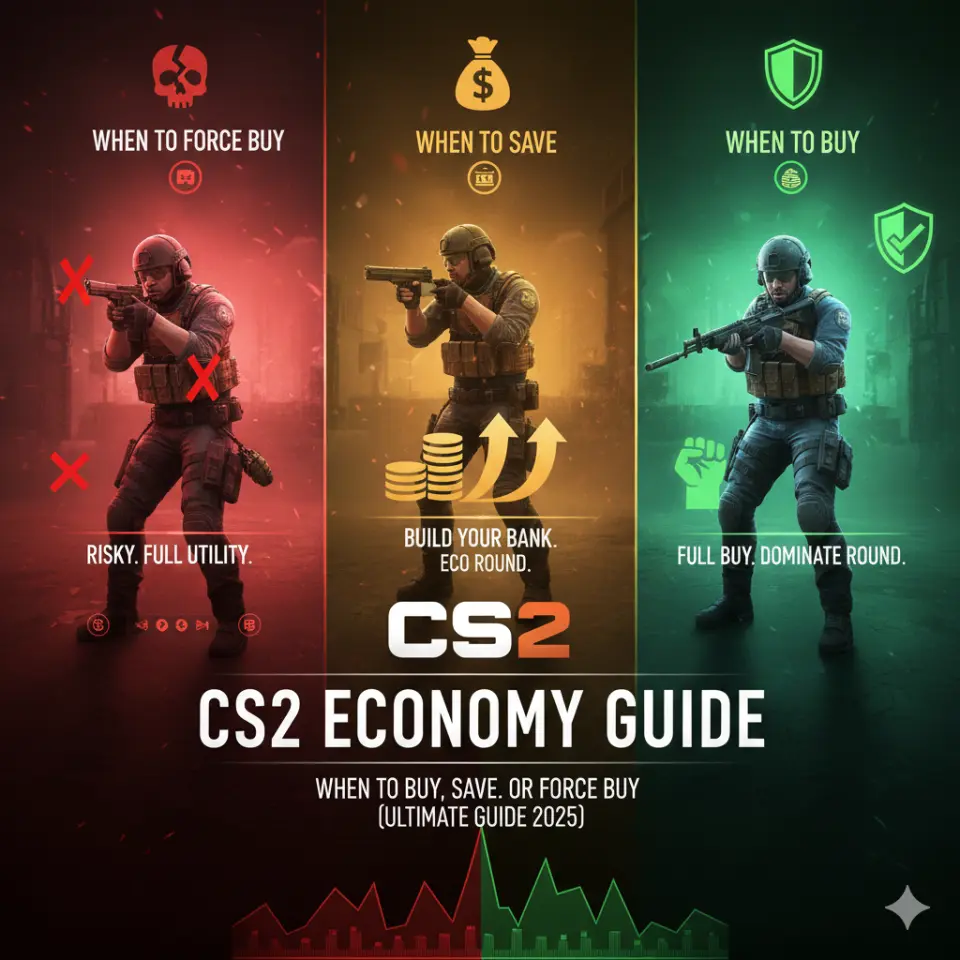
In competitive shooters like Counter-Strike 2 (CS2), aim and reflexes are crucial — but money management and smart buys are just as important. A well-timed buy or save can swing rounds, while a bad economic decision can cost you entire half. This guide dives deep into when to buy, save, or force buy, how to coordinate with your team, and how to maximize your win potential.
Let’s break down the economy flow, round types, decision patterns, and strategy — so you can climb competitive ranks smartly.
Why Economy Strategy Matters in CS2
- Weapons, armor, and utility cost money; without enough cash, you're stuck with default pistols and no grenades — easy pickings for opponents. CS2 Guide – The Ultimate Guide For CS2+2CS2 Guide – The Ultimate Guide For CS2+2
- Effective economy management lets your team control map pressure, use utility, buy rifles, and execute coordinated plays. Poor economy often means disorganized buys, weak loadouts, and frequent losses. CSGO-Guides.com+2Dot Esports+2
- Round outcomes — wins, bomb plants, kills — together with loss bonuses and kill bonuses, influence how much money your team gets. Understanding that flow helps you plan ahead. CS2Hype+2CSGold+2
So, economy isn’t just about money — it’s a strategic resource. Managing it properly often separates good players from great ones.
The Types of Rounds: Buy, Save (Eco), Force, and Half Buys
In CS2, each round give players a decision: invest for full weapons, partially invest, or save — depending on your team's economy and round situation. Recognizing when to do what is key. CS2Hype+2CS2Hype+2
🔹 Full Buy / Standard Buy Round
- What is it: Rifles (AK-47, M4), full armor (kevlar + helmet), and full utility (grenades, flashes, smokes) — sometimes a defuse kit (for CT side). CS2Hype+2CS2 Guide – The Ultimate Guide For CS2+2
- When to do it: When you (or your team) have enough money — typically after winning pistol or eco rounds, or after enemy eco rounds. Common if loss bonus or win bonus accumulated. CS2Hype+2Dot Esports+2
- Why it matters: Full buy gives best chance to win: better firepower, utility to execute or retake sites, better survival chances.
🔹 Eco / Save Round
- What is it: Minimal purchase — default pistols (Glock, USP), or maybe light pistol (P250) or no buy at all. Little or no utility; skip armor sometimes. smonker.com+2CS2 Guide – The Ultimate Guide For CS2+2
- When to do it: When your team’s funds are low, or after a heavy buy + loss — to accumulate enough money for a full buy next round. Losing many rounds in a row? Time to eco. CS2Hype+2CS2Hype+2
- Why it matters: Avoids wasting cash on weak buyouts, preserves potential for a strong comeback. Giving enemy cheap guns or SMGs cheaply is manageable when you eco.
🔹 Force Buy (or Partial / Half-Buy) Round
- What is it: A mid-level buy: SMGs or cheaper rifles, limited or no armor, minimal utility. Sometimes upgraded pistol + kevlar. CSGO-Guides.com+2CS2Hype+2
- When to do it: If economy is poor but team needs to contest a key round (e.g. prevent enemy winning streak, defuse point, or after bomb plant). Also used to surprise the enemy or punish an eco. CS2Hype+2CS2Hype+2
- Why do it: Risky but can pay off — catching enemies with weaker gear off guard, creating a reset in opponent economy, or stopping momentum.
🔹 Half Buy / Light Buy (if applicable)
- Less common term in CS2, but refers to intermediate buys — sometimes a rifle or SMG + minimal utility/armor. Used if you want some firepower but still conserve money for next round. CSGO-Guides.com+1
How CS2’s Economy System Works: Rewards & Money Flow
Understanding cash flow helps you predict when to buy/save. Some important mechanics in CS2 economy:
- Round win bonus & bomb-plant/defuse bonus: Winning or planting/defusing adds cash to each player. CS2 Guide – The Ultimate Guide For CS2+2CS2 Guide – The Ultimate Guide For CS2+2
- Loss bonus: Losing consecutive rounds increases the loss bonus. This helps sustain the economy if you lose several rounds. CSGold+2CS2Hype+2
- Kill rewards & weapon kill bonuses: Different weapons (SMGs, rifles, pistols) have different kill rewards; sometimes cheaper weapons carry higher kill bonuses — useful in eco or force-buy rounds to farm economy. Tech k Times+2CS2 Guide – The Ultimate Guide For CS2+2
- Weapon & utility costs vs. return value: Understanding what a gun or a grenade costs vs. potential kill or round outcome helps decide cost-effectiveness for buys/saves. CS2 Guide – The Ultimate Guide For CS2+2CS2 Pulse+2
With these mechanics, you can plan — sometimes two or three rounds ahead — whether to save now, buy now, or gamble with a force buy.
When to Buy, Save or Force — Round-by-Round Decision Guide
Here’s a practical decision-making flow, depending on your economy and round context:
✅ Full Buy — Go For It When:
- Team has sufficient funds (ridiculously high funds or after win/eco).
- You just won a pistol or eco/anti-eco round.
- You want to pressure enemies (who may be on eco or weak buy).
- Strategy demands full utility (smokes, flashes, grenades) — executing on bomb sites, retakes, map control.
🔄 Eco / Save Round — Use When:
- Funds are low across the team.
- After a heavy buy + loss round.
- Opponent economy seems strong — better to save and re-buy later.
- You aim to buy next round with full rifles/utility rather than weak gear now.
🎯 Force / Half Buy — Consider When:
- You can't afford full buy but need to contest important round (matchpoint, bomb plant, economy reset).
- Opponent is likely eco or weak — catching them off guard.
- Team agrees to gamble with cheap gear but good aim or surprise strategy.
- You rely on kill bonuses / SMG bonuses to farm money.
Important: Always coordinate with your team. A lone full-buy when teammates eco = 1v5 disadvantage. It’s one of the most common mistakes. CSGO-Guides.com+2CS2Hype+2
Team Economy & Communication: Why Individual Money Doesn’t Matter Alone
Even if you personally have enough money, CS2 is a team game. Buying when teammates can’t afford rifles or utility often results in unbalanced fights and quick losses. Some key practices:
- Always check teammates’ money before buying.
- Use voice or quick chat to coordinate “eco”, “buy”, “force” rounds. CS2Hype+1
- If you have surplus money, consider dropping weapons (rifle, utility) to teammates with low funds — helps full-buy as a team. CS2 Guide – The Ultimate Guide For CS2+1
- Adapt buy strategy to collective economy, not just personal money.
Advanced Economy Tactics & Mindset
Once you understand basic buy/save/force rhythms, try to adopt advanced plays:
🔸 Track Enemy Economy & Predict Their Buys
- Watch how many players die, whether bomb was planted — helps judge if enemy will eco, force, or buy next round. CS2 Guide – The Ultimate Guide For CS2+2CS2 Pulse+2
- If enemy economy is weak → full buy with rifles + utility to punish.
- If enemy might force buy → avoid overbuying; maybe half buy or eco to survive.
🔸 Use Utility Smartly — Utility Over Guns, Sometimes
A well-placed smoke, flash, or molotov often wins rounds more reliably than a rifle with no grenades — especially on saved/eco/half-buy rounds. CS2 Guide – The Ultimate Guide For CS2+2CSGO-Guides.com+2
🔸 Weapon Choices Matter for Economy Rounds
SMGs, budget rifles, and upgraded pistols offer good kill bonuses at low cost — ideal for eco or force buys. Use them wisely rather than overspending. Tech k Times+2CS2Hype+2
🔸 Be Ready to Adapt — Each Round Is Different
Don’t get stuck in a rigid rhythm. Round outcome, enemy behavior, bomb plants, economy swings — all change things. Stay aware and adapt.
When Buying a New Account Makes Economic Sense
Sometimes — even with perfect economy knowledge — your account’s history (low trust factor, limited hours, smurf-level gear) may hinder your play. A fresh, clean account with good trust, unlocked Premier mode, and full potential can give you a strategic edge.
If you want to skip the grind and step into better lobbies with smooth matchmaking, consider getting a prepped account from a trusted marketplace. For example:
Such accounts help you focus purely on gameplay and economy strategy — no distractions from account limitations.
Common Eco & Economy Mistakes (To Avoid)
| Mistake | Result |
|---|---|
| Buying alone while teammates eco | Unbalanced fight, likely loss |
| Overspending utility or guns | Lose next round due to weak economy |
| Never eco / always force buy | Economy collapse, long losing streak |
| Ignoring enemy economy | Surprise buys catch you off-guard |
| No team coordination | Chaotic buys, wasted money, unstable rounds |
Avoid these, and your win-rate will improve — not just due to aim or skill, but smart financial decisions.
Sample Round-by-Round Scenario (Economic Flow Example)
| Round | Team Money per Player | Round Decision | Expected Loadout / Strategy |
|---|---|---|---|
| 1 (Pistol) | $800 | Pistols only | Default pistols, no armor/utility |
| 2 (if lose pistol) | ~$1900+$loss-bonus | Eco or Light Buy | Pistols / cheap utility, avoid full buy |
| 3 | ~$3500–$4000 | Full Buy (if team pooled money) | Rifles, kevlar+helmet, utility |
| 4 (if lost round 3) | Low economy | Eco or Force Buy (SMGs/pistols) | Cheap SMG/pistol + limited utility |
| 5 | With loss bonus + some money | Full buy if pooled | Best possible guns + utility |
| 6+ | Based on performance | Adaptive — buy / eco / force depending on money and previous rounds | Adjust strategy per situation |
This flow shows how economy cycles can be used for comeback, momentum control, and strategic buys.
Final Tips & Mindset for Sustainable Success
- Always think 1–2 rounds ahead: Don’t buy just because you have money — buy for future rounds’ strength.
- Communicate with teammates: Unified economy decisions often win games.
- Prioritize utility & team balance over flashy buys: A rifle + utility + team coordination is better than solo AWP with no support.
- Adapt — don’t rigidly follow meta: Each match’s flow changes; what worked in round 3 might fail in round 7.
- If your account’s trust / history / experience is limited, a fresh high-trust Premier account can help you focus purely on economy and skill.
👉 For that, you can check a ready-to-use option here: buy CS2 premier account